AlphaGo++ A foundation AI that scales across many game classes — and ships in production
AlphaGo solved Go. AlphaZero generalized across perfect-information games. AceGuardian does the next thing: one foundation model trained across imperfect-information games (poker, Mahjong, Guandan), with a conversational and auto-research layer sitting on top of the gameplay AI, deployed in production across multiple operators.
A decade of quiet work by a founder whose first paper on this was in 2005.
Four angles, each verifiable, each grounded in published work. Pick the one that fits your beat and we'll back it with founder access, advance ecology data, and on-the-record sources.
Story 1 · The manifesto
"GTO is a toy model — the field has moved past it"
Five-ish years of "GTO is solved" turns out to rest on weak ground. The foundation paper disclaims its own claim if you read past the abstract. Pluribus, the "beat top pros" result everyone cites, was reviewed: small sample, narrow conditions, never reproduced in the multi-table multi-format games people actually play. DRL trained on the actual game is the correction the field has been waiting for. The contrarian-AI piece your readers haven't seen.
Story 2 · The synthesis
"AlphaGo++ — the AI that closed the gap"
AlphaGo's research DNA, Stockfish's production discipline, cross-game-class generalization, and a conversational research engine on top. The first AI for strategic games that finishes what both the research labs and the production engines started. The AI-in-games landmark piece.
Story 3 · The provocation
"AI doesn't beat humans in poker. Cheating does."
Pluribus didn't actually beat humans in the games people play, and its data didn't even reach significance. But bots, real-time assistance, and collusion tooling do beat humans in real games every day. AceGuardian's anti-cheat watches around 30% of the online poker market and catches 90%+ of known bots at 99% precision. The poker-integrity exposé piece.
Story 4 · The field guide
"What the algorithms can't do"
Three things AI keeps failing to do in expert domains where it's marketed as a replacement. It can't run autonomously, it doesn't actually outperform, and it can't teach. Poker is the cleanest case study because the ground truth is closed-form, but the same pattern shows up in medicine, law, finance, and education. The cross-domain feature piece (Atlantic / HBR / Wired register).
Each angle has a long-form piece behind it (next slide). Pick yours; we'll set the briefing.
What you get if you cover this
Access, exclusives, on-the-record sources
Direct access to the founder (no publicist in the middle). Falsifiable claims you can pressure-test. Domain experts who go on the record. Advance exclusives when the angle warrants one. Thanh runs his own press conversations.
Founder access
Sit with Thanh
A real conversation, 30 minutes or longer. The technical claims, the manifesto, the cheating story, the inside view from working at industry direction level. On the record or background.
Advance access
Ecology report pre-brief
The cross-platform ecology data before it goes public. You get the methodology in advance so you can pressure-test it before you write.
Demo + experts
Live demo plus coach and operator interviews
A live demo running across NLHE, PLO, MTT, Squid, Mahjong, and Guandan. Coach interviews with GTO Lab, Uri Peleg, Brad Wilson, and Andrew Seidman. Operators willing to speak to what the integration actually changed.
Coverage shape is flexible: a standard editorial piece, a co-created longform for a deeper partnership, or an advance exclusive when the angle is unique enough to warrant one. Tell us what you're writing and we'll fit the access to the piece.
Read before you write
The substance library — six published pieces, fully backed
Each piece is a complete argument with citations and falsifiable claims. Email Thanh for the full versions; pre-publication PDFs are available for reporters.
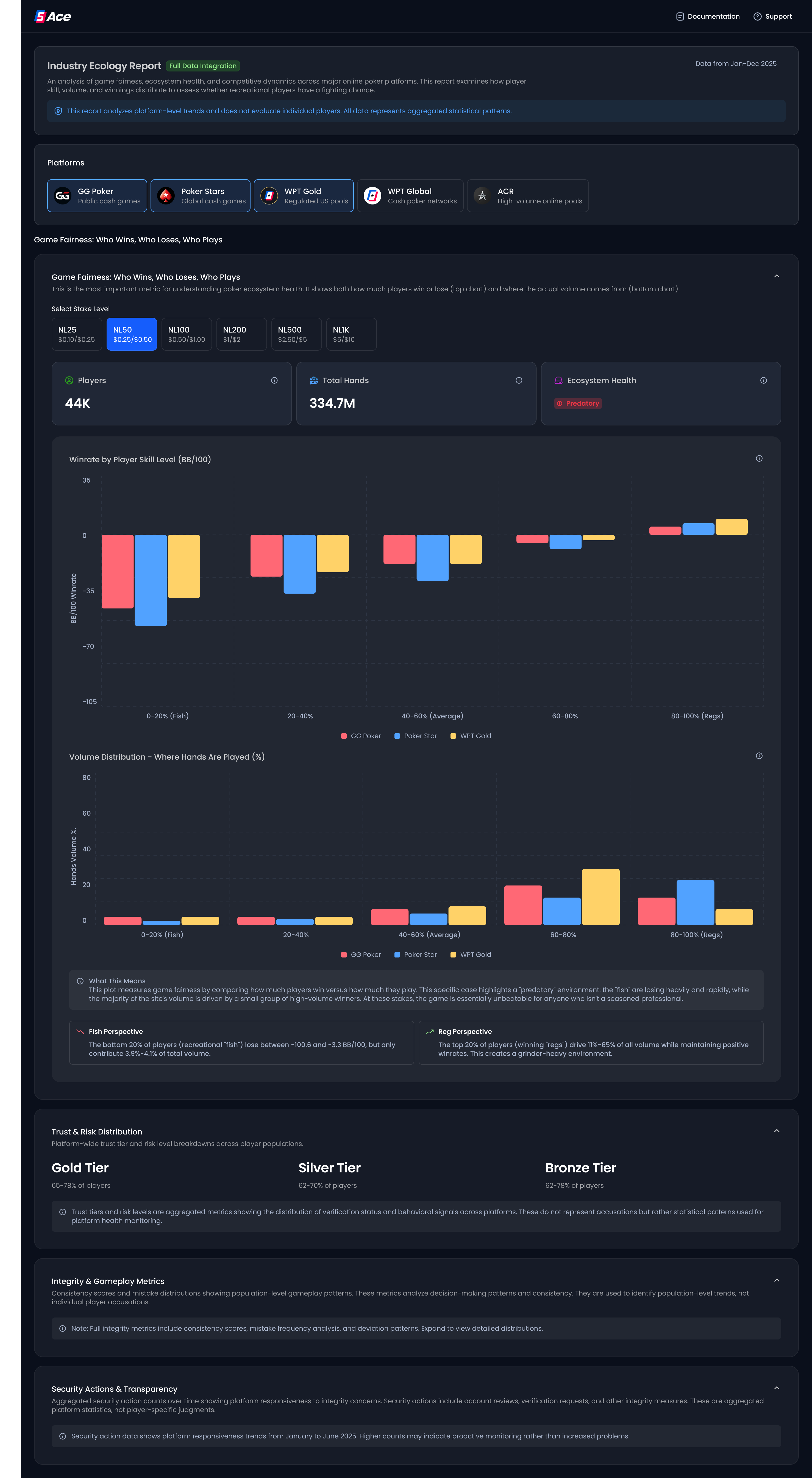
A cross-platform ecology report comparing major poker platforms on softness, skill, and integrity. Methodology open at publication. Every operator gets invited to contribute data. Email Thanh for the advance pre-brief.
Story 2 · why the synthesis is real
Two camps tried. Neither finished the job.
The AI-in-games beat has two well-covered camps. A third camp has been finishing what they started, and the press hasn't caught up yet.
The research camp: AlphaGo, AlphaZero, DeepStack, Libratus, Pluribus. Deep research labs (DeepMind, CMU, Meta AI, OpenAI). Beautiful results in published papers. But none of them went into production. None of them solved real-world game settings (varied formats, opponents, multi-table dynamics, ICM, rake, exploitation). And none of them demonstrated superhuman strength across more than one game class. The Pluribus "beat top pros" claim, when reviewed, turns out to have been a narrow experiment with a sample that didn't reach significance, and the result was never reproduced in real games.
The production camp: Stockfish, Chess.com. Real users, real deployment, real engagement. But only chess. One game class, no path to generalize, no conversational layer, no research engine on top.
The synthesis: AceGuardian and QuintAce. Deployed in production like Stockfish and Chess.com, built on the research DNA of the AlphaGo line. We then cracked the problems both camps left open: a foundation model that generalizes across game classes (poker, Mahjong, Guandan), a conversational and auto-research layer sitting on top of the gameplay AI, and a feedback loop where the research output trains the gameplay AI.
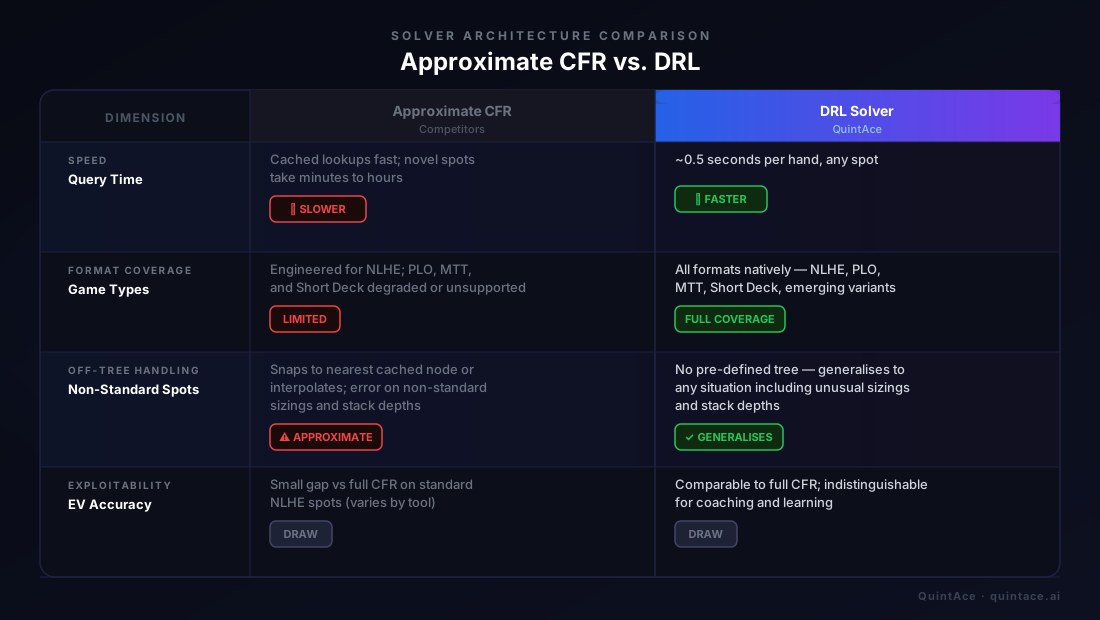
DRL foundation model versus CFR-based competitors. The ceiling, visible.
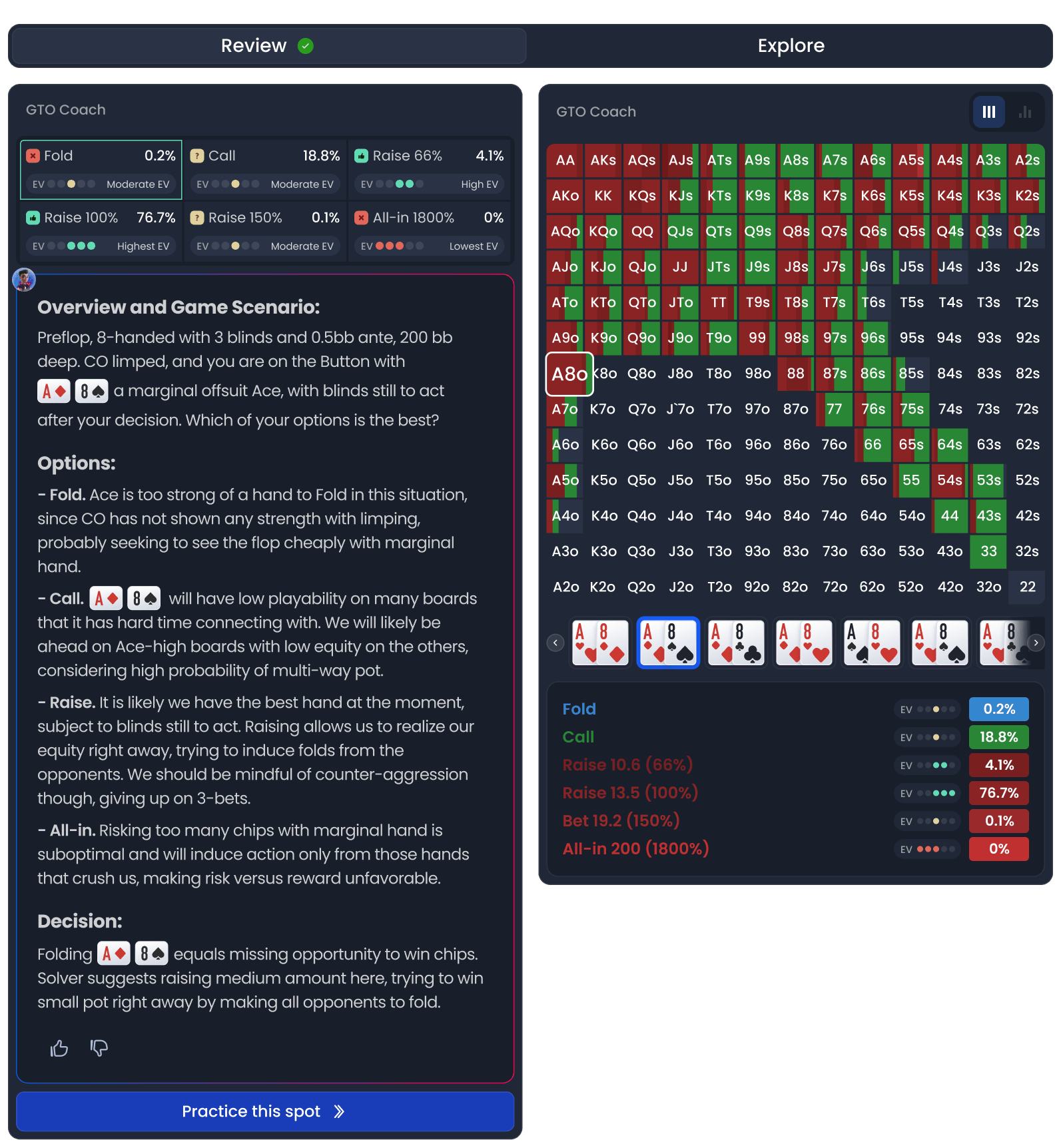
The deployed product surface. Review (text analysis) and Explore (live strategy grid), both running on the DRL foundation model. Not a research demo.
The founder — the arc you can verify
Academic AI researcher, engineering executive at scale, then back to the 2005 poker-AI work
Thanh Tran. CS PhD from KIT (Karlsruhe Institute of Technology). AI research group leader at AIFB, Karlsruhe's Semantic Web group. Visiting Assistant Professor at Stanford. Roughly 6,000 citations on Google Scholar, ranked top 5 in Semantic Search and top 50 in Web Search on the 2016 Google Scholar Global Index. "Most Cited Article 2006–2010" from the Journal of Web Semantics.
Academic AI · 2005–2014
Original poker-AI work + foundational semantic search
First built poker solvers and bots with his CS students starting in 2005. At KIT and AIFB, co-founded Semsolute and built SearchWebDB, the first natural-language semantic search over billion-scale data. Won the 2008 Billion Triple Challenge.
Executive at scale · 2014–2020
Helped Upwork go public
Executive role through Upwork's path to IPO. Upwork hit a $6.5B-plus valuation by 2019. Operational experience taking research engineering to public-company scale.
Industry direction · 2020–present
Co-CEO of A5 Labs · strategic direction across the A5 Group brands
Co-CEO of A5 Labs, the leading anti-cheat provider in poker, powering game integrity for most major sites. Strategic direction across the A5 Group brands, including the WPT acquisition and the growth of WPT Global and ClubWPT Gold.
Now · 2025–
CEO of AceGuardian and QuintAce — independent AI infrastructure for poker and gaming
AceGuardian is the foundation AI for strategic games. QuintAce is the player-facing app. Both run as one independent company serving the poker and gaming industry, with integration partners across multiple regions and brands. The platform itself is the maturation of work Thanh started with his CS students in 2005, built now with the compute that didn't exist for fifteen years.
What we've actually built — what no one else has shipped
Five claims, each verifiable, each a "first" in its category.
First
DRL foundation model trained on imperfect-information games at production scale
Not a research prototype. Live in operator integrations. Same architectural class as AlphaGo and AlphaStar, applied to a problem class neither was built for.
Many games, one model
Cross-class transfer: poker, Mahjong, Guandan, and beyond
Poker variants: NLHE, PLO (4-card, 5-card), Short Deck, MTT with ICM, Bomb Pots, Stand-Up Squid, All-in or Fold, Flash, Global Spins. Plus games outside poker: Mahjong, Guandan (200 million-plus players in Asia), and other imperfect-information strategic games. Same foundation model. New game added in under a week.
Sub-2s
Solver-grade response in real time
Sub-2-second action latency in production. Suitable for real-time integration into live operator surfaces. No precompute, no abstraction collapse.
AceGuardian's anti-cheat: 90%+ coverage of all known bots in the industry at 99%+ precision, across roughly 30% of the online poker market under behavioral monitoring. Five threat vectors picked up from gameplay data alone: bots, collusion, real-time assistance, account sharing, chip dumping. Server-side; players install nothing.
Closed-loop research engine
Gameplay AI plus conversational AI plus auto-research, in continuous feedback
The gameplay AI is one half. The other half is a conversational and auto-research layer built on top of an LLM, paired with the gameplay AI. Together they propose hypotheses, verify them against the solver, output publishable articles and books, and feed the verified heuristics back into the gameplay AI as training signal. A continuous research loop, not a one-off methodology document. Output so far: long-form manifesto pieces, technical briefs, two book-length series (Squid Blood Battle, Squid Hunt Progressive), and 30+ coach-attributed pieces. All solver-backed, methodology open.
9+ variants on one engine
Independence + integration + integrity
The independent AI infrastructure layer — already live
QuintAce and AceGuardian run as one independent infrastructure layer. Not a subsidiary of any operator. Already integrated with the WPT family and with non-WPT major operators across LATAM, APAC, and worldwide markets.
"AI doesn't beat humans in poker. Cheating does." Pluribus didn't actually beat humans in the games people play, and its data didn't reach significance. But bots, real-time assistance, and collusion tooling do beat humans every day. AceGuardian's anti-cheat is what's pushing back, in production.
Live partners
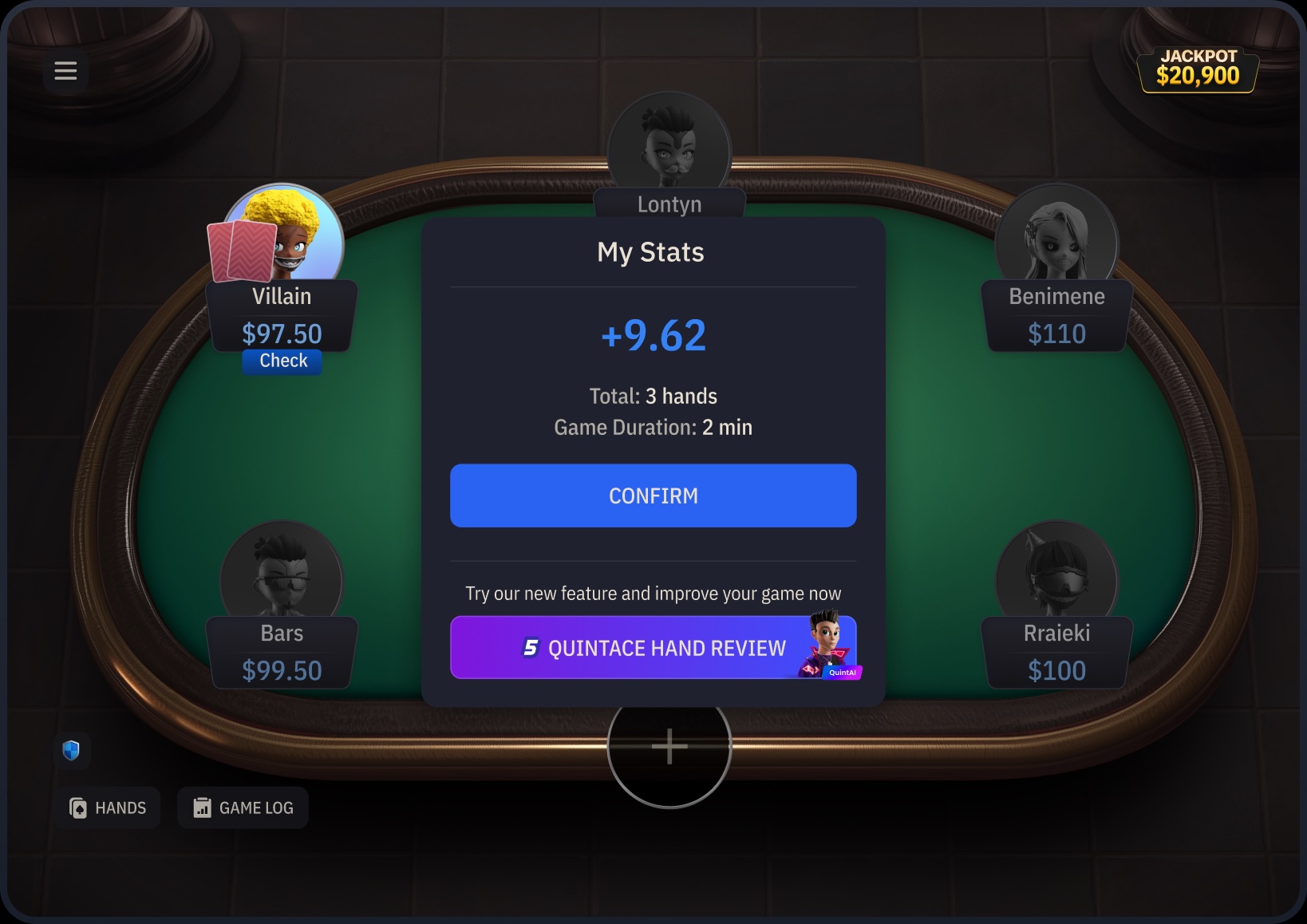
WPT Global — post-hand QuintAce CTA over the live table
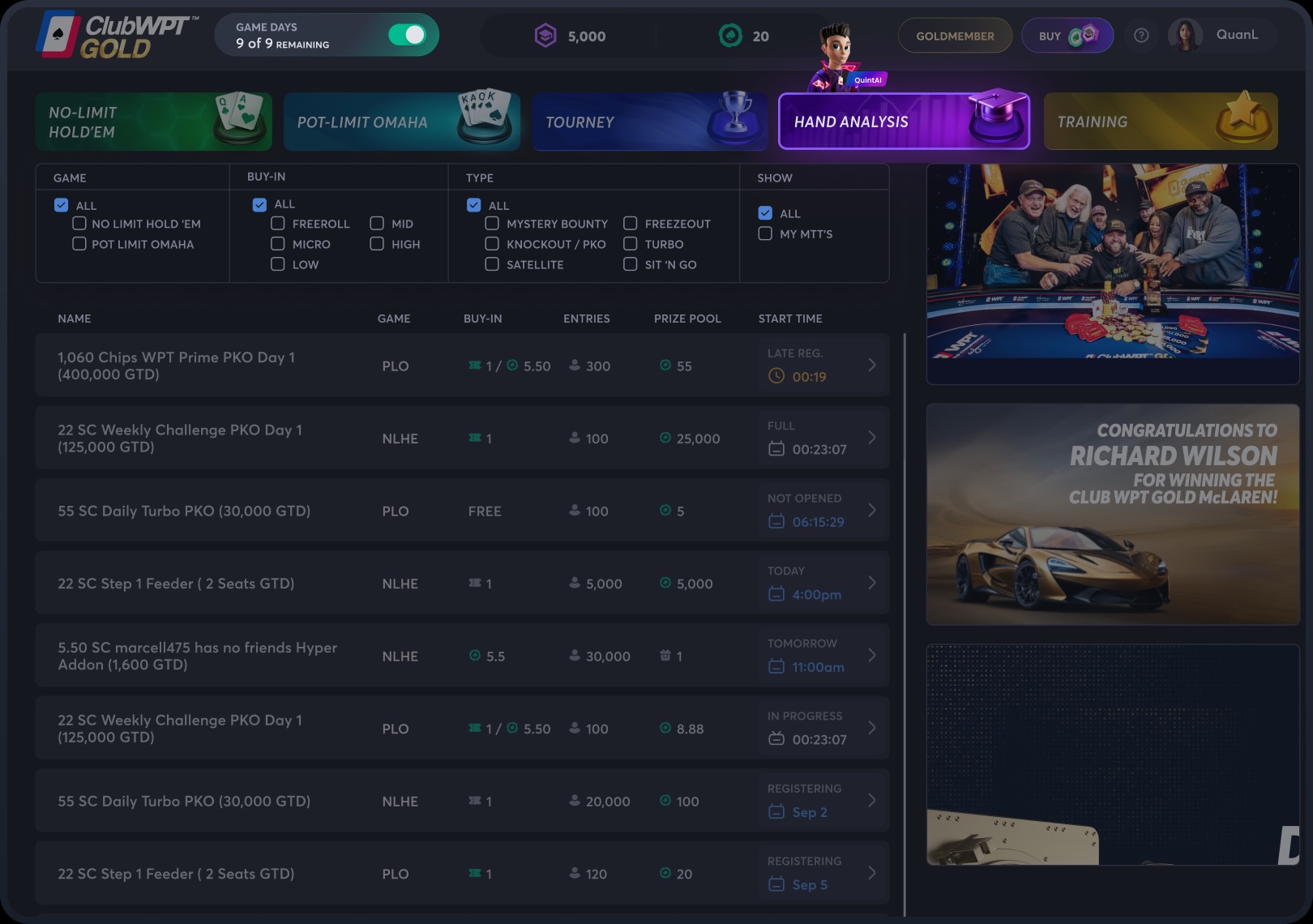
ClubWPT Gold — Hand Analysis as a first-class lobby tab
Coach + content endorsements — different specialties
Nick Petrangelo · Daniel Dvoress · Uri Peleg · Brad Wilson · Andrew Seidman
Nick and Dan (GTO Lab) are two of the most respected high-stakes MTT minds in poker. Uri Peleg is the Stand-Up Squid specialist who authored the first strategy manual for that format. Brad Wilson (Chasing Poker Greatness) is a community-facing coach and AMA host. Andrew Seidman brings methodology-grade partnership work.
Support from WPT brand ambassadors
The WPT Global ambassador roster
The world-class players and content creators who put their name on the platforms QuintAce powers. The roster keeps expanding as the integration footprint grows.
Start the conversation
Pick the story. We'll set the briefing.
Email Thanh directly with the angle you want to cover. We'll line up the founder conversation, the advance materials, the coach and operator interviews, and the demo, sized to the piece you're writing.