Why We Exist
Build the foundation model for strategic decision-making.
Mission: Build the foundation model for strategic decision-making — proving it first in the hardest games, then scaling to any competitive domain.
Vision: Become the foundational intelligence layer for strategic decision-making — from competitive games to real-world adversarial domains — enabling AI agents that plan, learn, exploit, and teach at superhuman levels.
Imperfect information games — hidden cards, deception, multi-agent dynamics, long-horizon planning — are the hardest class of strategic problems in AI. Traditional solvers cannot scale. Big AI labs (DeepMind, Meta FAIR) publish research but never commercialize. The $85B+ online gaming industry is waiting for a foundation model.
AceGuardian built it. And the same capabilities that master poker transfer to any domain where agents compete under uncertainty: gaming, trading, negotiation, cybersecurity, and beyond.
The Opportunity
$85B+ runs on games that no AI can properly play.
The gaming industry spends $13–15B/year on B2B software — but for the hardest class of games (poker, card games, strategy games), no commercial AI exists that can play at superhuman level, detect cheaters by understanding gameplay, or coach players in plain language.
$85B+
Online gaming runs on unsolved games
$1.7–3B
Addressable market today
DeepMind proved game AI is possible (AlphaGo, AlphaStar). AceGuardian proved it is profitable. We are the only company that has turned deep reinforcement learning game AI into production-grade commercial products.
$4.5–8.4B
Projected SAM by 2030
120–220
Potential game producer customers
500+
Poker operators globally
The Technology You'll Work On
A DRL foundation model — not a solver.
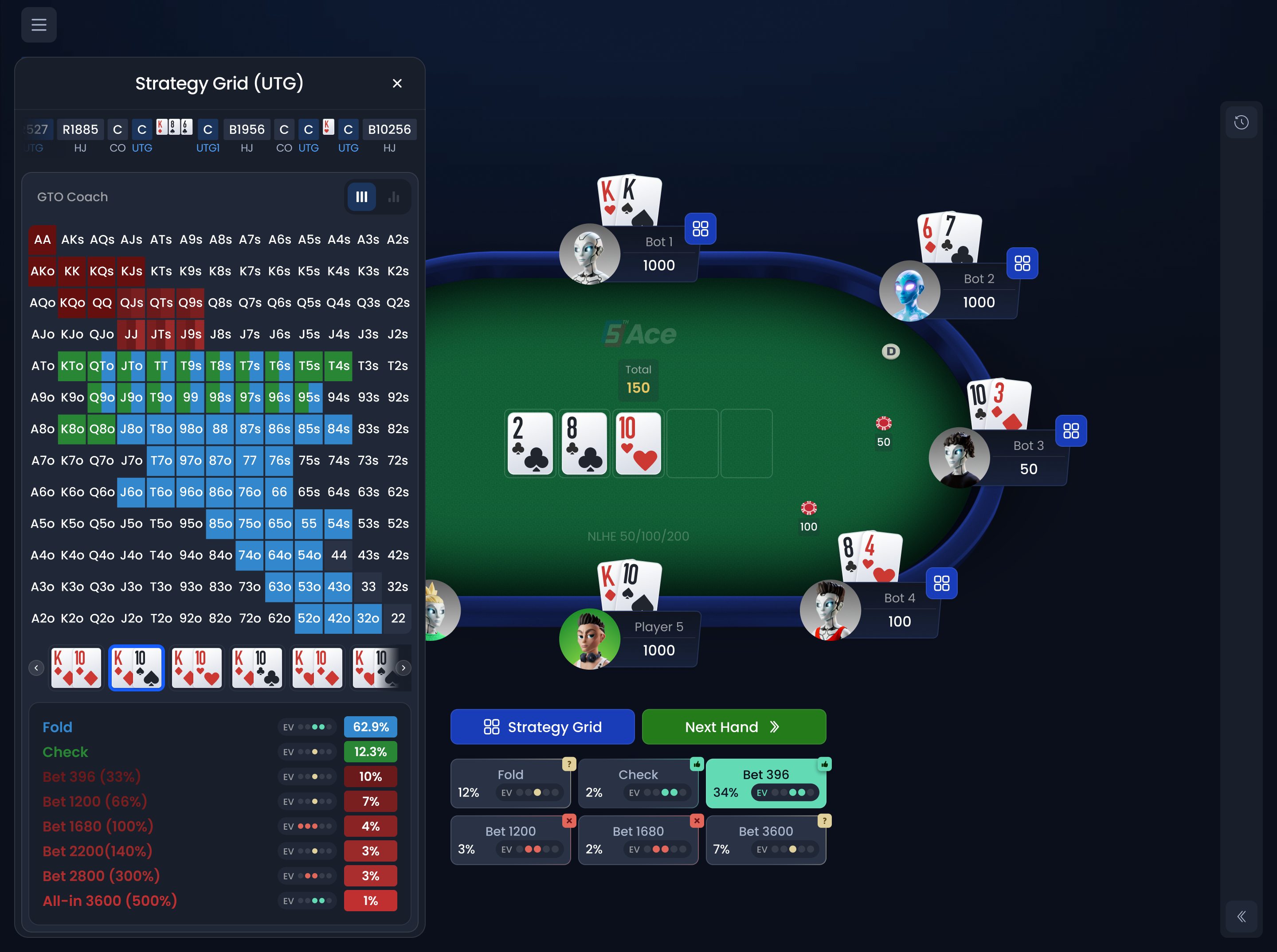
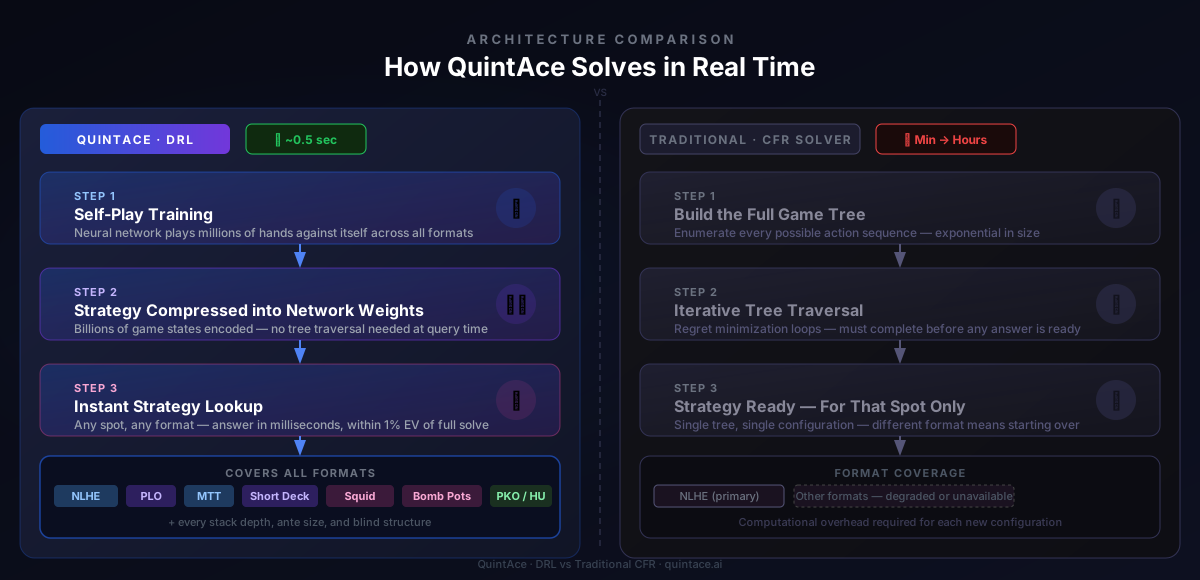
Unlike CFR-based competitors (GTO Wizard, PioSolver), AceGuardian builds deep reinforcement learning models that learn generalized strategic reasoning via self-play. This is a fundamentally different architecture.
M
Foundation model for imperfect-information games. DRL-based — learns strategic reasoning, not pre-computed equilibria. Trained via millions of games of self-play per minute.
D
Trained on ~30% of online poker market data. Via B2B operator integrations. Opponent modeling from real gameplay — not just theory, but how humans actually play.
T
Transfers across ~100 game formats. NLHE, PLO, MTT, Short Deck, Bomb Pot, Squid — all from the same architecture. New variant AI in under a week.
F
Dual-use flywheel. Same model powers coaching AND anti-cheat. Every improvement to the AI compounds across all three pillars.
S
Solver + deep RL integration. Test-time inference using MCTS-like search — similar to AlphaGo but for imperfect-information games. Improving decisions both in and out of distribution.
The Business
B2B AI platform. $35–50M Y1 target.
1
Five revenue streams from one model. Gameplay AI for game producers (~$18M), anti-cheat API (~$7.5M), QuintAce API fees (~$5.4M), coaching API (~$3M), bot/NPC licensing (~$1.5M), expansion games (~$1.3M).
2
B2B customers. Game producers (90+ globally, Tier 1: Evolution, Aristocrat, $3–5M+/yr), poker operators (A5 platforms converting, new external operators), game studios (bot/NPC licensing).
3
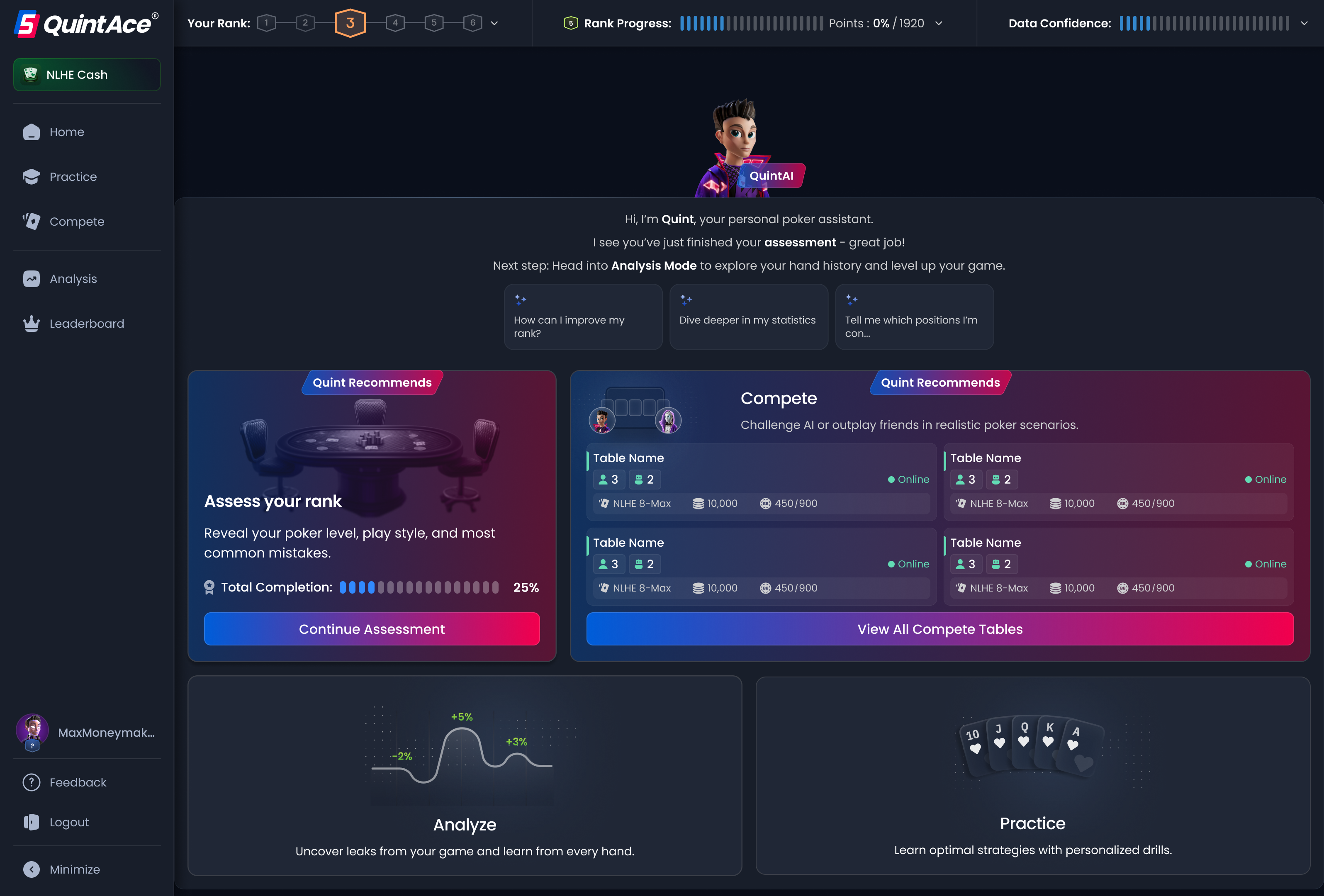
Palantir-like positioning. AI IS the product, not a feature. Deep-tech platform multiples: 10–25x at scale. QuintAce is the consumer showcase that demonstrates the tech.
4
Category creator — no playbook to copy. AceGuardian = B2B AI platform. QuintAce = consumer coaching. Clean structure for distinct investor pools and valuation multiples.
Traction to date: Live B2B client generating $400K+/month. ~30% of online poker market data processed via operator integrations. QuintAce consumer app live with real users. Coach partnerships in progress (Daniel Dvoress, Nick Petrangelo). $17M invested to date, indefinitely funded.
Q1 2026
Entity Separation
Formalize AG/QA structure. Lock intercompany API terms. IP assignment.
Q2 2026
First Contracts
Close pipeline game producers. Formalize A5 anti-cheat contracts with data rights.
Q3 2026
Scale & Expand
New Tier 1 logos. External operators. Guandan cross-game demo.
Q4 2026
Platform Revenue
15+ customers. $35–50M ARR run-rate. Series A positioning.
Pre-revenue. ~$12M/year burn. Indefinitely funded by founder & private backers. $17M invested to date. ~104 people total across AceGuardian Technologies.
The Team
~46 people. 3 teams. Deep-tech DNA.
AceGuardian is the foundational AI company within AceGuardian Technologies (~104 people total). You'll work on the core platform that powers anti-cheat, gameplay AI, and expert systems — the engine behind the entire ecosystem.
17
Anti-Cheat
Gameplay-based detection, behavioral analysis, multi-platform security
24+
Gameplay AI
DRL foundation model, self-play, solver integration, cross-game transfer
5
AceExpert
Expert system, MCP tools, scoring, strategy services
Remote-first
Global team
Direct access to CEO & CTO
High autonomy, low bureaucracy
Engineering-driven decisions
Pre-IPO equity
Research → Production pipeline
Entity separation underway
Pre-scale. Your work shapes the platform, not just a feature. Direct influence on direction at a pivotal growth stage — entity separation underway, first external contracts closing, B path ahead.